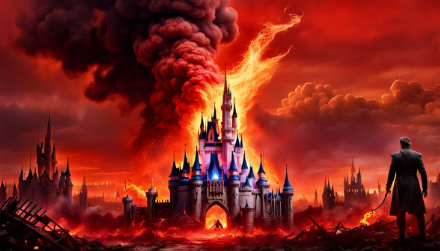
Disney, a company that has provided so many childhood memories for all of us, from the classic movies, the classic songs, to the unforgettable Disney Parks Experience, in some way, we all grew up with this company, but over the last 6 years, something has happened to this company we grew up loving. Since 2019, Disney has become a brand, a shell of its former self. Across streaming, theatrical films, television and even its public image, Disney has spent the last several years trying to repair its brand recognition and many self-inflicted damages. The result has been a company that looks less like an untouchable cultural empire and more like a giant struggling to find the formula that made it special in the first place.
Disney’s own earnings tell part of the story:, based off Disney’s November 2022 and Fiscal Year 2018 earnings report revenue rose from $59.4 billion in fiscal 2018 to $82.7 billion in fiscal 2022 and $88.9 billion in fiscal 2023, but net income fell sharply over the same stretch, from $12.6 billion to $3.2 billion in fiscal 2022, yet this does not explain why culturally Disney is not as big as it once was.
Horizon High School Senior Dara Lennon stated that Disney’s older era worked because the company took familiar stories and made them feel new. In his view, recent Disney projects lean too heavily on “bits and pieces of old stories,” while making the message too obvious rather than letting it live underneath the story. Horizon High School Senior Dominic Ferrera made a similar point from a different perspective, saying Disney’s newer films do not hit the same way because they are no longer carrying the same emotion and creative spark that defined its golden age of movies like The Lion King or Toy Story. That complaint shows up again and again in how people describe Disney’s post-2019 output: familiar brands, familiar formulas, less excitement.
For decades, the company could recycle fairy tales, comic-book heroes and animation concepts because each one arrived with a sense of event and wonder. Several interviewees said that the sense is gone. Horizon High School Junior John Valentine called modern Disney “kind of creatively bankrupt.” His point was not that Disney stopped trying altogether, but that trying is not the same as delivering something memorable. That distinction is central to Disney’s current struggle. They may be profitable, but the magic that the company once held is now gone
In November 2019, Disney introduced the biggest structural issue with the company in Disney+. The service grew quickly, helped by Marvel, Star Wars, Pixar and the COVID-19 pandemic, forcing a shift to at-home entertainment. However, that growth came with steep losses. In early 2023, Disney+ reported its first subscriber decline. Disney ended that quarter with 161.8 million Disney+ subscribers, down 2.4 million from the prior quarter, and later that spring, the company said the streaming unit still had an operating loss of $659 million, even after price increases and lower marketing costs narrowed the deficit.
The company rushed projects out to Disney+, sometimes at the expense of theatrical value, then kept changing the rules for consumers. Valentine argued that Disney+ made sense during the pandemic, but that the company damaged itself by releasing films in theaters and on the service at the same time, or sending them to the platform too quickly afterward. Lennon said the same thing more bluntly: “Disney had a good streaming idea, but poorly utilized it.” That criticism is backed up by Disney’s own strategy shifts, which moved from aggressive subscriber growth to aggressive cost-cutting, including a 7,000-person layoff announcement and a promise to cut $5.5 billion in costs.
Streaming helped Disney preserve relevance during the pandemic, but it also trained audiences to expect more content for less money. Once Disney taught viewers to wait for Disney+, theaters became less central, in turn losing a significant amount of box office revenue. So when the company raised prices to chase profitability, the service became less attractive to the general consumer. Reuters reported that Disney’s losses narrowed in part because of pricing and cost control, not because the service suddenly became a runaway hit.
The film business has paid the price. Disney was still capable of hits, but the misses became too visible and too expensive. In 2023, four of the five biggest box-office bombs that year belonged to Disney, including The Marvels, which grossed $206 million worldwide and reportedly cost Disney $237 million. At the same time, Universal edged Disney at the global box office for the year, underlining that Disney was no longer the king of the movie theaters.
Parks are the exception, and that matters. The “downfall” narrative often ignores the fact that Disney’s parks remained one of its strongest businesses. Disney’s own reporting shows that the Parks, Experiences and Products segment rebounded sharply after COVID-era closures, with revenue and operating income recovering strongly in fiscal 2022 and continuing to perform well in fiscal 2023. Reuters reported that the parks business helped lift operating income by 23% in one quarter.. So Disney is not failing everywhere. It is failing in the parts of the business that are supposed to extend the brand beyond the parks.
For many consumers, the parks still represent family tradition and comfort, but the movies and shows now carry more baggage. Some of that baggage is cultural. Disney became a target in the Florida fight over the Parental Rights in Education Act, known by critics as the “Don’t Say Gay” bill, after the company first tried to stay neutral and then opposed the law. Reuters reported that Disney’s public clash with Florida became a major political and business issue, while workers staged walkouts over the company’s response. The backlash fed a broader narrative that Disney had become too ideological for some viewers and too cautious for others.
The interviews show how powerful and how messy that perception has become. Valentine said some criticism of Disney’s so-called wokeness “ I feel comes from a media environment that trains people to react before thinking…Disney can go too far when identity becomes the whole character instead of part of a larger story.” Lennon made a similar point “representation is fine, but Disney has made it feel too obvious.” This shows that Lennon believes the problem is not representation itself so much as execution of said representation. Disney has struggled to make its messages feel natural, which lets critics attack the messaging and lets supporters defend what they see as basic inclusion. The company ends up alienating both sides.
The leadership story runs through all of it. Long-time Disney CEO Bob Iger departed the company in 2020, with Bob Chapek replacing him. However, due to Chapek’s struggles, Iger returned in November 2022. It signaled strategic confusion to investors, employees and consumers alike. Under Chapek, Disney leaned hard into the streaming scale. Under Iger’s return, it swung back to profitability, layoffs and triage. The company has basically spent the post-2019 period correcting one extreme with another. That may stabilize finances, but it does not restore confidence in the underlying creative machine. Disney can cut costs faster than it can rebuild trust.
In the end, Disney’s problem since 2019 is not one failure. It is the accumulation of several: creative exhaustion, streaming overreach, theatrical cannibalization, political backlash, leadership instability and a brand that no longer feels as universally trusted as it once did. The parks still work because they sell memory, ritual and experience. The rest of the company is struggling because it has lost the sense that Disney means something bigger than content output and corporate messaging. That is the real danger. A company can survive bad quarters. It has a much harder time surviving when people stop believing it still knows how to make magic.