

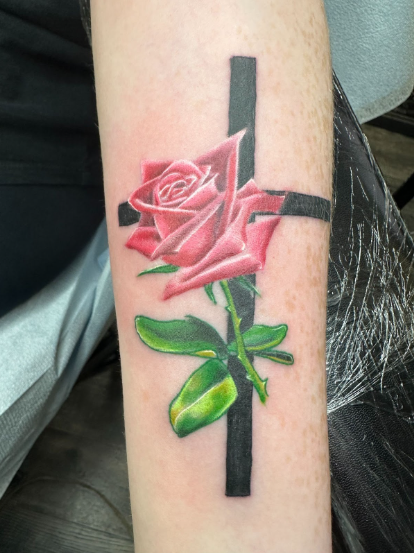
To some, tattoos and piercings are nothing more than ink and metal, personal style choices with no deeper meaning. To others, they can carry stereotypes and snap judgments, shaping first impressions before conversations even begin. A needle touches the skin and suddenly you’re “reckless.” A hoop hands from cartilage and you’re “asking for attention.” For teenagers especially, body modification doesn’t just decorate the body, it invites scrutiny.
The story lives in the space between ink and judgment. Between teens experimenting with identity and adults who never stopped claiming theirs. Between those with a single piercing and those fully covered in art. Between the people being judged and the people holding the needle.
Because tattoos and piercings aren’t the problem. The discomfort with self-expression is.
The first piercing Horizon graduate Terah Malecki remembers is her cartilage at age 12. Since then, she has accumulated 10 piercings and two tattoos. She says they give her happiness and confidence, explaining, “I want to show people who I want to be and where I’ve been.” Malecki says she has experienced little judgment, mostly receiving compliments, even noting that her employer did not care about her tattoos or piercings during the hiring process. While she believes body modifications are more normalized now, she adds, “I think teens with many facial piercings are stereotyped as rebellious most often.” To those who view tattoos and piercings negatively, Malecki says, “They are an expression of that person and who they want to be… many people just do the same with tattoos or piercings.”
Not everyone approaches body modifications with the same certainty. Sophia Black, a senior at Horizon, currently has four ear piercings and plans to get two tattoos later in life. While she supports self-expression, she emphasizes caution, saying, “It is so permanent and they have to live with it… I feel like an adult should have to be in on it.” Black acknowledges judgment still exists, but notes that society has become more accepting. When asked what judging someone based on tattoos or piercings says about a person, she explains, “I think it’s about how they’re raised… they’re just passing their judgment off,” and adds that it is wrong to judge something simply because it feels normal to criticize.
For Miranda Leitner, a 2013 Horizon graduate, tattoos and piercings have long been part of her life. She got her ears pierced at three months old and her first tattoo at 17. Now, she has over a dozen piercings and is fully tattooed. Leitner says she has rarely felt judged, explaining that she taught herself not to care about others’ opinions. While she admits, “I regret my first couple when I was young,” she would not remove them, instead viewing them as lessons. Her advice to teens is simple: think it through. “I’m all for getting tattoos just to get them, but make that decision when you’re older. For teenagers, I think the tattoo should be meaningful to some extent, especially your first one,” she says, also stressing the importance of quality and cost. In her experience, the more expensive the tattoo, the better the quality of it.
Olivia Dunn, a senior at Grand Junction High School, has her ears pierced and an eyebrow piercing. Dunn also adds she will most likely get a tattoo in the future. She got her eyebrow pierced because she thought it looked cool and matched her personality. When asked if she ever felt judged, Dunn says, “Not really, I’ve mainly only got compliments, and if someone does dislike it, I don’t really care, it’s none of their business.” However, Dunn does believe that teens with tattoos and piercings do get stereotyped. She explains, “A lot of older people stereotype them in many harmful ways without even getting to know the person.” As for what Dunn would say to someone who thinks piercings and tattoos are ‘bad,’ she says, “Honestly, just grow up. It’s a form of self expression and times are changing. If it makes someone happy, why are you so bothered by it?”
Tattoos and piercings are never just ink and metal. They’re choices, stories, and proof that identity doesn’t ask permission. For teens especially, they become lightning rods for judgment, assumptions made before a voice is heard or a story is known.
Across generations, the message stays the same: self-expression makes people uncomfortable when it refuses to fit expectations. Some marks are impulsive, some are meaningful, some are both. But all of them belong to the person who carries them.
Maybe the issue isn’t teens making permanent choices. Maybe it’s society struggling to accept that they’re allowed to.